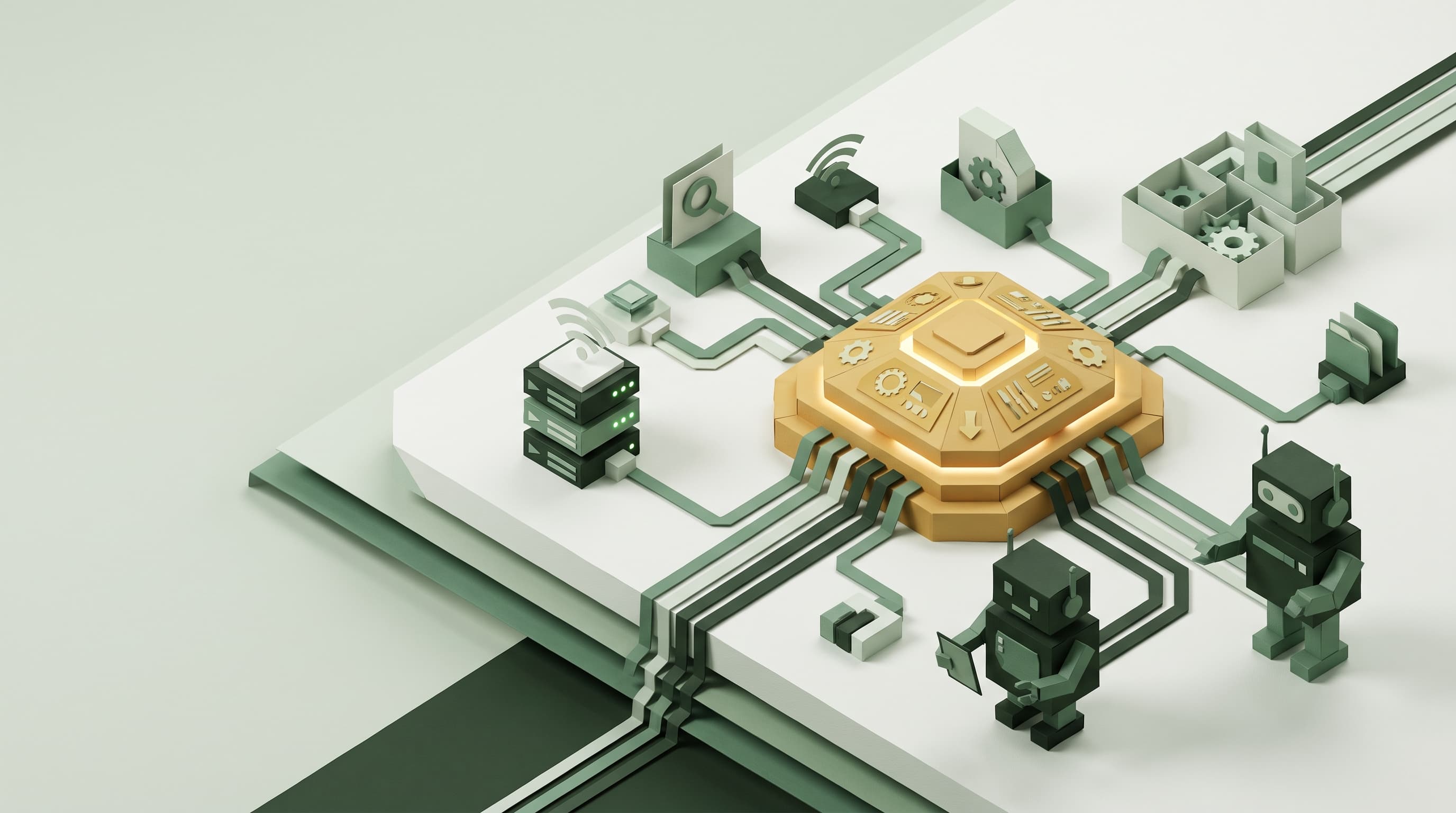
You have probably been told you need AI. You may have already bought some. The problem most businesses run into next is that the tools don't talk to each other, the results don't carry across the business, and nothing you have built quite adds up to a system. That gap is what an AIOS fills.
An AIOS, or AI Operating System, is the control layer that coordinates AI agents, workflows, data, and tools across a business so they operate as one system rather than a collection of disconnected experiments.Think of it less as another piece of software you buy and more as the operating layer that everything else plugs into — the equivalent of what Windows or iOS does for a device, but for the AI running inside your company.
This post explains what an AIOS actually is, why its architecture matters more than any single tool you choose, what to weigh up before adopting one, and how Dynome builds one for businesses like yours.
An AIOS is a control layer, not another tool
The mistake almost everyone makes early is treating AI as a shopping list. You buy a chatbot here, an automation there, a transcription tool somewhere else. Each one works on its own. None of them know the others exist.
An AIOS is the layer above all of that. It does the work an operating system does on your laptop: it schedules tasks, decides which AI agent handles what, manages memory so context is not lost between interactions, holds data securely, and controls who and what is allowed to act. In technical terms, it provides scheduling, context management, memory, storage, and access control as shared services that every AI capability in your business can draw on.
The point of an AIOS is not to do one clever thing. It is to make every clever thing in your business run as part of the same system.
That distinction is the whole game. A single AI tool gives you a feature. An AIOS gives you an organisation that learns, because everything it does feeds back into one shared layer of institutional knowledge rather than into ten separate silos.
Model and system agnostic is the part that matters most
Here is the question that should worry any leader buying AI right now: what happens when the model you built everything around is no longer the best one?
The AI landscape changes every few months. A model that leads today is overtaken by next year. If your AI is welded directly to one provider's model, every one of those shifts becomes a rebuild. A well-designed AIOS solves this by beingmodel agnostic— the architecture treats the underlying model as a component you can swap, not a foundation you are stuck with.
The same principle applies to your existing software. A good AIOS issystem agnostic: it sits as a layer of orchestration above your CRM, your finance system, your support desk, and your project tools, connecting them rather than replacing them. It becomes the fabric that joins fragmented systems together and lets work flow across them end to end.
The practical payoff is independence. You are not betting your business on one vendor, one model, or one tool surviving. When something better arrives, you adopt it underneath a layer that stays stable. That is what turns AI from a risky bet into durable infrastructure.
What an AIOS actually changes inside a business
The benefits are not abstract. They show up in cost, speed, and capacity.
Cost.Repetitive work — customer service, invoice processing, first-pass screening, reporting — gets automated and coordinated rather than handled by growing headcount. A content function that took four people can be run by one or two overseeing AI workflows.
Speed.Analysis that used to take a team weeks can become a plain-English question answered in seconds. The business stops waiting on human throughput for every decision and starts reacting closer to machine speed.
Capacity.A system scales differently from a team. It handles more volume without the management overhead, the hiring, and the quality drift that come with adding people. Your constraint shifts from how many staff you can manage to how good your systems are.
There is a strategic effect too. Because an AIOS captures and structures what your business knows — every interaction, every preference, every decision — it compounds. The longer it runs, the more it knows, and the harder that accumulated, integrated intelligence is for a competitor to copy. It becomes your company brain.
AI Operating System
Dynome's AI Operating System is one programme that combines strategy, audit, and hands-on implementation into a single AIOS configured to your business, whether you are a 10-person team or a 400-person enterprise.
Learn more about the AI Operating SystemWhat to think about before adopting an AIOS
An AIOS is powerful, but it is not something to bolt on carelessly. A few questions are worth answering honestly before you start.
Is your data in a state the system can use?
An AIOS runs on your data. If that data is scattered, inconsistent, or locked inside tools that don't connect, the system inherits those problems. You don't need perfect data to begin, but you do need an honest picture of where it lives and what shape it's in. That assessment is usually the first real piece of work.
Is the architecture genuinely agnostic, or is it a lock-in dressed up?
Plenty of products call themselves an AI operating system while quietly tying you to one model or one ecosystem. The test is simple: can you swap the underlying model, and can it integrate with the tools you already run? If the answer to either is no, you are buying a tool, not an operating layer.
Will people actually use it?
The best architecture in the world fails if it sits alongside how your team really works instead of inside it. Adoption is not an afterthought — it is the difference between a system that compounds and one that gathers dust. A unified interface that brings AI alongside your existing tools, in one place rather than ten, is what makes that adoption stick.
How Dynome builds your AI Operating System
This is exactly what Dynome'sAI Operating Systemprogramme is built to deliver. It is not an off-the-shelf product and it is not a strategy deck with no path to execution. It is one structured programme that takes you from where you are to a working system.
It starts with an audit and maturity assessment — an honest read of your current AI capability, your data landscape, and what is realistically possible within your constraints. From there it defines a strategy tied to business outcomes, builds and deploys real, production-ready AI capabilities inside your business, and wraps them in a unified presentation layer that sits alongside your existing tools. Then it stays with you to drive adoption, measure impact, and keep the system improving as both your business and the technology evolve.
The result is the thing most businesses are missing: not another AI experiment, but an operating layer that makes AI genuinely work — model agnostic, integrated with what you already run, and built around your scale rather than a generic template.
If you want to understand how an AIOS could enhance your business, the best next step is a conversation. No obligation, no hard sell, just an honest look at where you stand and what would move you forward.