Ask anyone who has been at your company for five years how a particular client likes to be handled, why you priced a deal the way you did, or which approach to a recurring problem actually works. They will tell you in seconds. Now ask where that knowledge is written down. In most businesses, the honest answer is: nowhere. It lives in people's heads, scattered across email threads, buried in old documents, and lost the moment someone leaves.
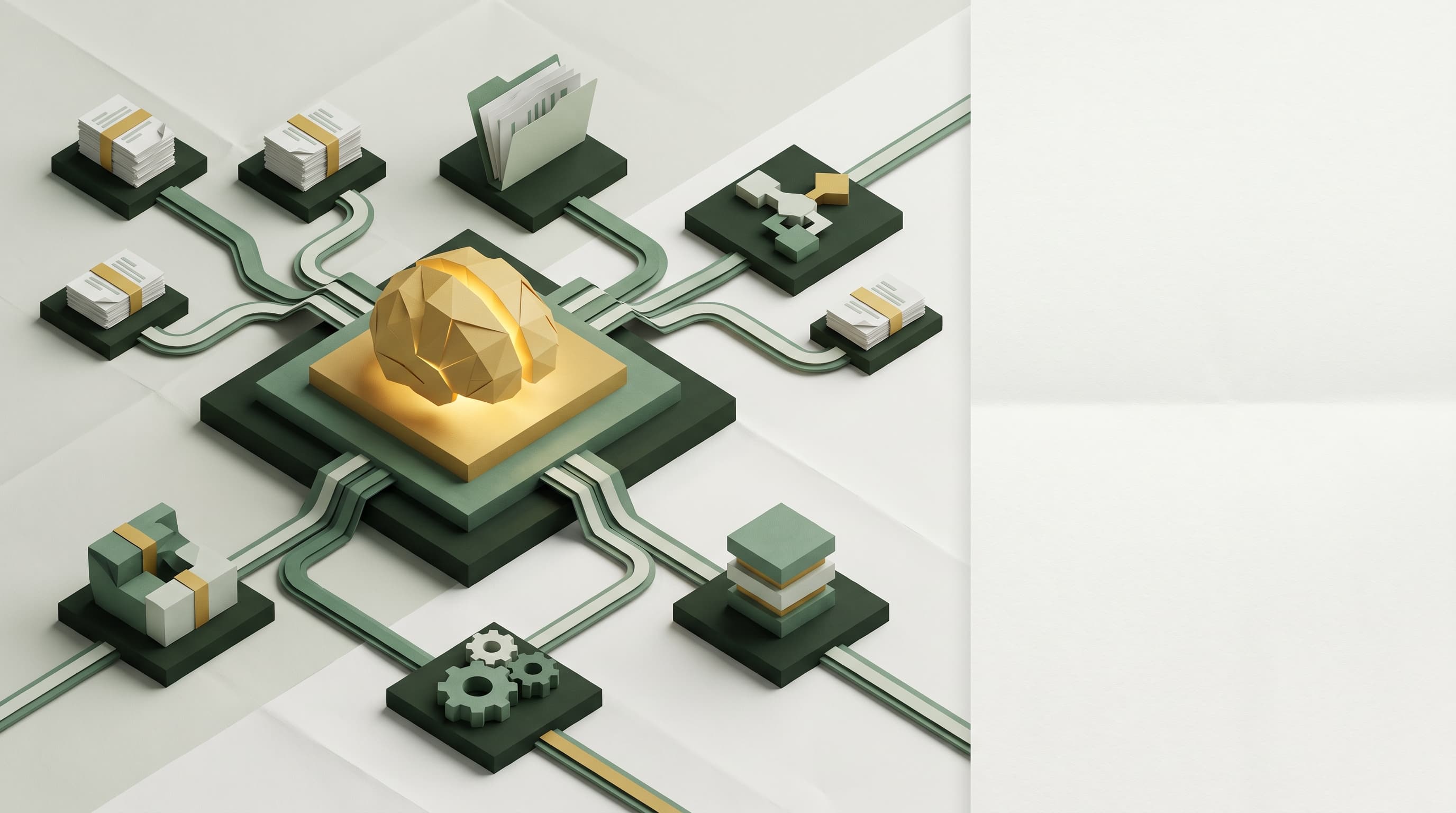
A company brain is a single, structured, continuously updated layer that holds what your business knows — its clients, decisions, processes, and preferences — in a form that both people and AI agents can read and act on.It is not a folder of documents and it is not a chatbot pointed at your files. It is the organised memory of how your company actually runs, kept current as the business moves.
This post explains what a company brain is, why it becomes more valuable the longer it runs, what data readiness really means before you build one, and where it fits inside a wider AI strategy.
A company brain is structured memory, not a pile of files
The reason most "knowledge management" efforts fail is that they stop at storage. A shared drive holds your files, but it does not understand them. A search bar finds a document, but it does not know that the document is out of date, or that the decision it describes was reversed three months later. A company brain is different because it captures relationships, not just files.
Underneath, it is built on a knowledge graph — a map of how people, clients, projects, documents, and decisions connect to one another. That structure is what lets it answer a real question rather than just return a list of links. Ask it about a client and it can pull together who owns the account, what was last agreed, the pricing that applies, and the open commitments, because it understands how those things relate.
It is useful to think of that knowledge in three layers. There isbusiness memory— your clients, projects, pricing, contracts, and the team itself. There isoperational memory— how work actually gets done day to day, the approval rules, the handoffs, the follow-ups. And there ispersonal memory— the individual context each person carries, which we will come back to.
A search bar finds a file. A company brain knows what the file means, whether it is still true, and what it connects to.
That last point is the whole difference. A pile of files is passive. A company brain is an active, queryable model of the business — the single source of truth that both your team and any AI you deploy can rely on.
Its value compounds, which is why it is worth starting early
Most tools you buy are worth roughly the same on day one as on day five hundred. A company brain is not like that. It is one of the few business assets that genuinely compounds: the longer it runs, the more it knows, and the more valuable every interaction with it becomes.
The reason is simple. Every decision you log, every client preference it records, every process it captures becomes context for the next question. A new hire who would have taken months to learn what experienced people "just know" can instead read the accumulated history of the business on day one. In documented cases, structuring this knowledge has cut onboarding time by close to half and lifted productivity by a third within six months.
There is a defensive side to this too. Institutional knowledge is one of the most fragile assets a company owns — a large share of it walks out the door whenever a long-serving employee leaves. Organisations relearn the same lessons and remake the same decisions because no one remembers the first time. A company brain captures that knowledge as it is created, so it stays even when people move on.
The strategic effect is the one that matters most. Because a company brain captures and structures what your business uniquely knows, it accumulates into something a competitor cannot simply buy. They can purchase the same software and hire similar people, but they cannot copy years of your structured, integrated decisions and context. The longer it compounds, the harder it is to catch. That is why the best time to start building one is earlier than feels necessary.
It is what finally makes AI agents reliable
Here is the part that has pushed the company brain from a nice-to-have to a near-requirement. The biggest blocker to useful AI automation is no longer the intelligence of the models. The models are extremely capable. The problem is that they do not know your business.
An AI agent is a piece of software that can take actions on your behalf — drafting an email, booking a meeting, raising an invoice. Without a source of truth to read from first, an agent guesses. It does not know your pricing rules, your client's history, or the decision you made last week, so it acts on stale or invented context and gets things wrong. With a company brain, the agent reads the truth before it acts, which is what makes automation safe and consistent rather than a liability.
This is why every major AI platform is now converging on the same pattern. The leading enterprise AI products are all, in their own way, building a private layer of company knowledge for their models to draw on. The industry has reached the same conclusion from every direction: a smart model is not enough on its own. It needs to know you.
Your data has to be in a state the brain can use
A company brain runs on your data, which means an honest look at that data is the first real piece of work — not an afterthought once the system is built.
This is the readiness question, and it is worth answering plainly. Where does your knowledge actually live? For most businesses it is spread across email, calendars, shared drives, chat tools, a CRM, a handful of documentation apps, and a good deal of it only in people's heads. If those sources are fragmented, inconsistent, or locked inside tools that do not connect to anything, a company brain will inherit those problems rather than solve them by magic.
The good news is that you do not need perfect data to begin. You need an honest map of where it sits and what shape it is in. A modern company brain connects to your existing systems and reads from them with the permissions you set, rather than demanding you migrate everything first. But the assessment comes before the build, and skipping it is the most common reason these projects disappoint.
How is this different from a personal "second brain"?
A second brain is the individual equivalent — a personal layer that holds one person's context, their writing style and tone, their preferences, and what they are allowed to access. Where a company brain captures what the organisation knows, a second brain captures what you know and how you work, so that AI acting on your behalf sounds like you and respects your boundaries.
The two are designed to work together. The company brain supplies the shared, business-wide truth; each person's second brain supplies the individual nuance on top. We will explore the second brain and why everyone will eventually have one in a future post.
Where a company brain fits in a wider AI strategy
A company brain is not a standalone product you bolt on and forget. It is the foundation that everything else depends on. Without it, your AI tools are clever but ignorant; with it, they are clever and informed.
This is why, at Dynome, the company brain is a core component of ourAI Operating Systemprogramme rather than a separate purchase. The operating system is the layer that coordinates AI agents and workflows across your business; the company brain is the shared memory that those agents read from before they act. One supplies the orchestration, the other supplies the context, and neither delivers its full value without the other.
The practical sequence is the same one this post has described: assess where your knowledge and data actually live, structure that knowledge into a brain the business can query, connect it to the tools and agents that will use it, and then let it compound. The businesses that start now will, in a few years, hold an asset their competitors cannot replicate.
If you want to understand what a company brain could look like for your business, and whether your data is ready for one, the best next step is a conversation. No obligation and no hard sell, just an honest look at where you stand and what would move you forward.