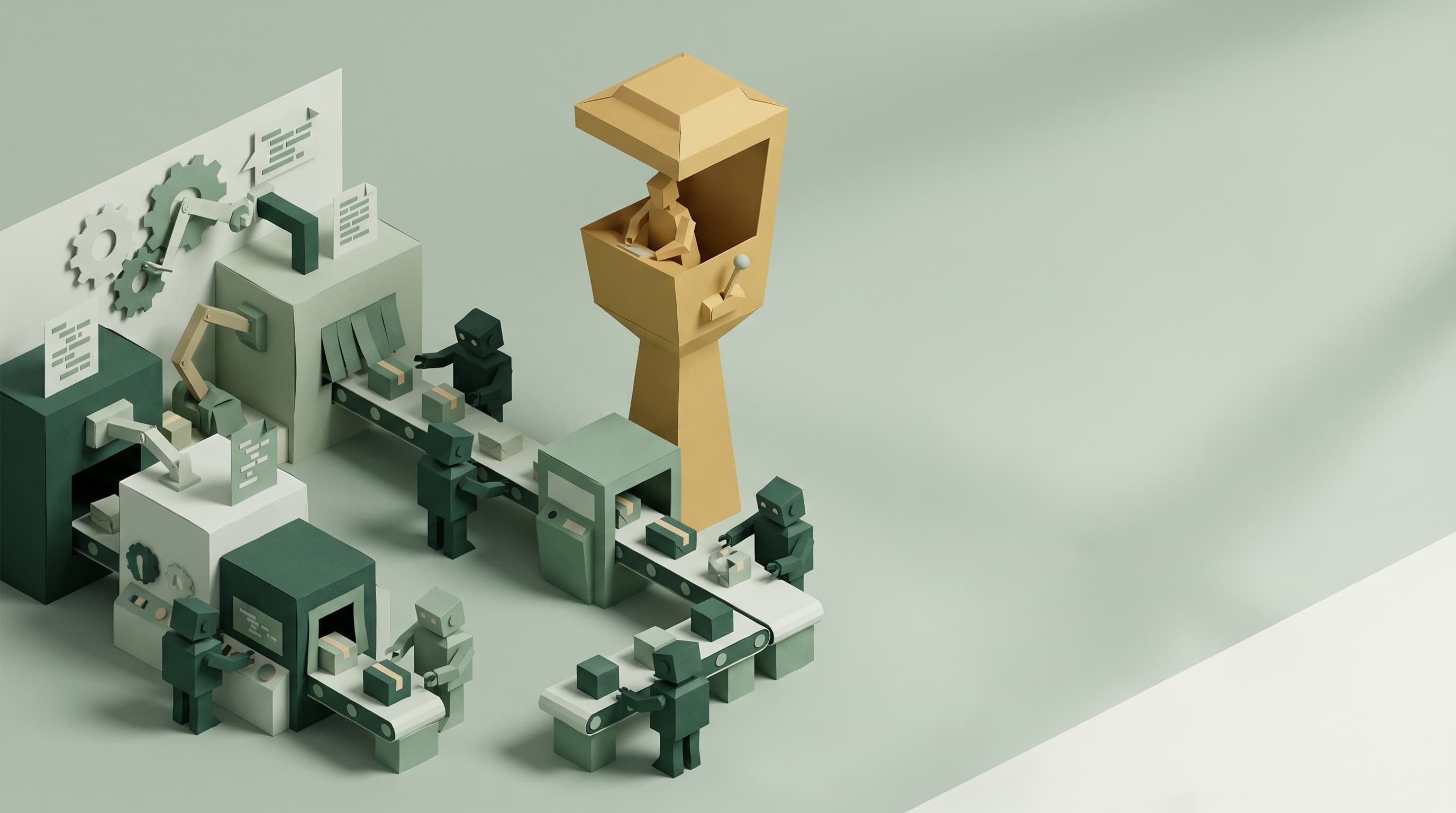
A new term has started appearing in how people describe AI-first companies: the AI native service. It is worth understanding, because it points to a genuine shift in how work gets bought and sold, not just another label for software with a chatbot bolted on.
An AI native service (AINS) is a full-stack business that solves a problem end to end, with AI doing the core work and people overseeing it, sold as an outcome rather than as a tool or a block of hours.A traditional firm sells you labour. A software vendor sells you a tool you then have to operate. An AI native service does the work itself and hands you the result. That is the whole distinction, and it changes the economics underneath.
This post explains what an AI native service is, how it differs from the AI tools and copilots you have probably already met, what it actually changes inside an industry, and why it matters for a smaller business even if you never intend to build one.
The category sells the outcome, not the hours
The easiest way to place an AI native service is against the two things it is not.
A traditional service firm or agency sells you labour. More work means more people, and cost scales in a straight line with output. A software tool, including most AI copilots, sells you something that makes your own people faster, but your people still do the work. AnAI copilot is AI that assists a human who remains responsible for the task.An AI native service inverts that: the AI executes the task end to end, and the humans in the business design, supervise, and handle the exceptions.
The result is that capacity stops scaling with headcount. In a traditional firm, ten people give you the capacity of ten people. In an AI native service, a small team supervising well-built AI systems can deliver many times that, because the systems carry the volume and the people carry the judgement.
A traditional firm sells you hours. A tool vendor sells you something to operate. An AI native service sells you the finished outcome and keeps the complexity to itself.
It is a business model, not a feature you switch on
The part that trips people up is assuming "AI native" describes a feature. It does not. It describes how the business is built.
A traditional company appends AI to systems that were never designed for it, and the automation feels like an afterthought. An AI native business is designed the other way around: the AI is the core operating engine, and the rest of the stack is rebuilt so that the AI can run natively. In practice that often means rebuilding the underlying systems entirely rather than wrapping a model around legacy software.
The clearest examples come from industries you would not expect to move first. In fund administration, AI native operators have rebuilt the whole stack, from the general ledger to the investor portal, so a team of a dozen engineers can do work that traditionally required hundreds of staff. In insurance, an AI native third-party administrator has used around twelve engineers to process claims more accurately than thousand-person incumbents. In mainframe migration, AI native firms report moving legacy systems at roughly ten times the speed of the established consultancies.
The pattern repeats across legal services, bookkeeping and tax, commercial insurance broking, and revenue cycle management. In each case the firm is not selling a smarter tool. It is taking on the entire job and delivering the result.
The gains show up as cost, speed, and accuracy
The benefits are not abstract, and they are measurable.
Cost.Because the work is automated and coordinated rather than handled by growing headcount, AI native platforms have reported operational cost reductions in the region of 20 to 40 per cent, while quality holds or improves. The constraint shifts from how many people you can hire and manage to how good your systems are.
Speed.Work that used to take weeks compresses into hours or minutes. AI native insurance broking has delivered coverage in hours rather than weeks. Voice agents in revenue cycle management secure approvals and resolve claims in real time rather than across days of back-and-forth.
Accuracy.This is the counter-intuitive one. Smaller AI native teams have outperformed far larger incumbents on accuracy, because the institutional knowledge that used to live in people's heads is encoded into systems that apply it consistently, every time, without the drift that comes with scale and staff turnover.
There is a strategic effect underneath all three. Because these systems encode what the business knows into the way it works, that knowledge compounds. The longer the system runs, the more it captures, and the harder that accumulated, integrated capability becomes for a competitor to copy.
Why this matters for an SME, even if you never build one
If you run a 30-person business, you are not about to rebuild your industry's full stack. So why does this category matter to you? For two practical reasons.
First, AI native services are increasingly something you can buy. The work you currently outsource to an agency, a bookkeeper, a broker, or a back-office provider may soon have an AI native alternative that is faster, cheaper, and more accurate. Knowing the category exists lets you ask the right question of any supplier: are you selling me hours, a tool, or an outcome?
Second, and more usefully, the principles behind AI native services are the same ones that make AI work inside your own business. You do not need to rebuild your entire company to borrow the model. The shift is from treating AI as a tool your people pick up to treating well-defined chunks of work as something a system can own end to end, with your people supervising. A single well-chosen workflow, designed this way, is often the highest-return AI project a smaller business can run.
That is exactly the kind of thing we look at in asolution designengagement: identifying which parts of how you work today could become AI native components, where the data and the process are in good enough shape to support it, and what the realistic payoff would be.
What to check before you rely on an AI native service
The category is real, but the label is unguarded. Plenty of firms will describe themselves as AI native when they are an agency with a chatbot. A few honest questions sort the genuine from the dressed-up.
How do I tell a real AI native service from a relabelled agency?
Ask where the work actually happens. In a genuine AI native service, the AI does the core execution and people handle oversight and exceptions; cost does not rise in a straight line as volume grows. If adding more clients still means proportionally adding more staff, you are looking at a traditional firm with better marketing. The economics give it away faster than the pitch deck does.
Where should an SME start with this?
Not by trying to become an AI native business overnight. Start by finding one process that is repetitive, rules-based, and well understood, and treat it as a candidate to be owned by a system rather than assisted by one. Get the data behind it into usable shape, build it properly, and keep a person supervising. Prove the model on one workflow before you extend it. The businesses that win with this approach compound it gradually, not all at once.
The bigger point is that AI native services are not a far-off idea for enterprises only. They are a working model, available to buy and possible to borrow, and the businesses that understand the category early will be the ones that put it to use before their competitors do.
If you want to understand AI native services properly and explore where they could be a relevant solution in your business, the best next step is a conversation. No obligation, no hard sell, just an honest look at where you stand and what would move you forward.