
A worked example, not survey data. The assumptions are visible so you can disagree with them.
Picture the scene
A site manager rings the hire desk on a Tuesday to send a scissor lift back. The programme had it finishing nineteen days earlier. Hire bills by the week rather than the day, so nineteen days of overrun invoices as three weeks. At £310 a week, £930.
Nobody escalates £930. There's no meeting about a scissor lift.
That same week though:
- The QS loses a day and a half pulling the backup together for a valuation
- Accounts keys in two hundred supplier invoices by hand
- The office manager chases a subcontractor for an insurance certificate that expired in August
- On site, a variation gets agreed verbally, and nothing is written down
Five of the seven, in a single week, landing on four different desks.
Not one of them is big enough to escalate on its own. Nobody has ever held the total. That's the problem, and it's got almost nothing to do with AI.
So let's add it up
First, imagine a company something like this and see what similarities it has with your own.
A 60-person regional fit-out and refurbishment contractor. £12m turnover, three live sites, eight completions a year. Rates are salary plus employer NI, pension and overhead, roughly salary times 1.3, divided by about 1,800 productive hours a year. That gives £25 an hour for admin and accounts, £40 for commercial, £45 for site management. Over 46 working weeks.
Here is what the seven workflows cost that business. "Reclaimable" is the share a system can realistically take off a person, which is never all of it, because somebody still handles the exceptions and signs the result.
Hours
| Workflow | Costs today | Reclaimable | Value |
|---|---|---|---|
| Timesheets to payroll and costing | 437 hrs | 70% | £10,500 |
| Payment applications, pulling the backup together | 576 hrs | 40% | £9,200 |
| Supplier invoices, 200 a month at 6 minutes to key and match | 300 hrs | 75% | £5,600 |
| O&Ms and handover packs, 8 completions at a week each | 296 hrs | 60% | £5,300 |
| Subbie approvals and expiry chasing, 45 firms | 133 hrs | 70% | £2,300 |
| Total | 1,742 hrs | 1,032 hrs | £33,000 |
Cash leaked
| Workflow | Basis | Value |
|---|---|---|
| Kit not off-hired on time | 30 events × 8 days × £45 | £10,800 |
Revenue unclaimed
| Workflow | Basis | Value |
|---|---|---|
| Variations agreed verbally on site, claimed late or never | 3–5% of variation value | £29,000 to £48,000 |
The reclaim rates are the arguable part, and they differ for a reason. Payment applications sit at 40% because the valuation is the QS's call and always will be; only the assembly goes. Invoice matching sits at 75% because most of it is mechanical and only the mismatches need a person. If you think a rate is wrong for your business, change it. That is the point of showing them.
The variations line is the largest and the least certain, which is uncomfortable. Fit-out projects commonly carry a 5% to 10% contingency, which is the industry's own estimate of how much change it expects. The assumption that 3% to 5% of it gets agreed on site and never formally captured is mine, and it's the softest number on the page.
It's also the one that never shows up as a cost, because money you didn't claim appears nowhere. It shows up as a disappointing final account that everyone blames on a difficult client.
Three different kinds of money, totalled only because nobody in the business ever has. On £12m of turnover, £73,000 to £92,000 is under one percent, which sounds survivable. Contractors turning over £3m to £15m run net margins of about 1.5% to 5%, and the CN100 average for 2026 was 3.4%. Take 3% and that's £360,000 of net profit, so a fifth to a quarter of it is going out through seven leaks nobody totalled. If your margin is nearer 2%, it's over a third.
Your own number will be different. The useful version of this exercise is the one you run on your own business, and it takes an afternoon.
Where to start, which isn't the biggest number
The instinct is to go after the biggest number, which is variations. You can't, not yet. Catching a variation at the moment it's agreed needs somewhere to put it, and that somewhere doesn't exist.
Look again and six of those seven lines fail at the same point, and it isn't the clever part.
- Hours written on a scrap of paper or sent in a WhatsApp message, never against a cost code
- The backup for an application spread across four people
- Nothing to match a supplier invoice against except the memory of whoever ordered it
- Handover documents scattered across drives and inboxes, rebuilt from nothing every completion
- Certificates with nobody's name against them and no record of when they run out
- The moment a variation is agreed on site captured nowhere at all
None of those are AI problems. They're filing problems. The information exists, it's just in a WhatsApp thread, a drawer, or somebody's head, so nothing can get at it.
So the first build is the dull one. One place where every certificate, policy, order, rate and date lives, with a name against it, where it came from, and when it runs out. It doesn't need anyone to believe anything about AI, and it's the only first move whose payback is measured against six lines of the ledger instead of one.
The Dynome AI Audit
The arithmetic above is a worked example on an invented firm. The AI Audit does it on yours: we size the workflows that are actually costing you hours, cash and unclaimed revenue, set an honest reclaim rate against each one, then set out the sequence that closes them. You get the ledger whether or not you build anything with us.
See how the AI Audit worksHow it actually pays back
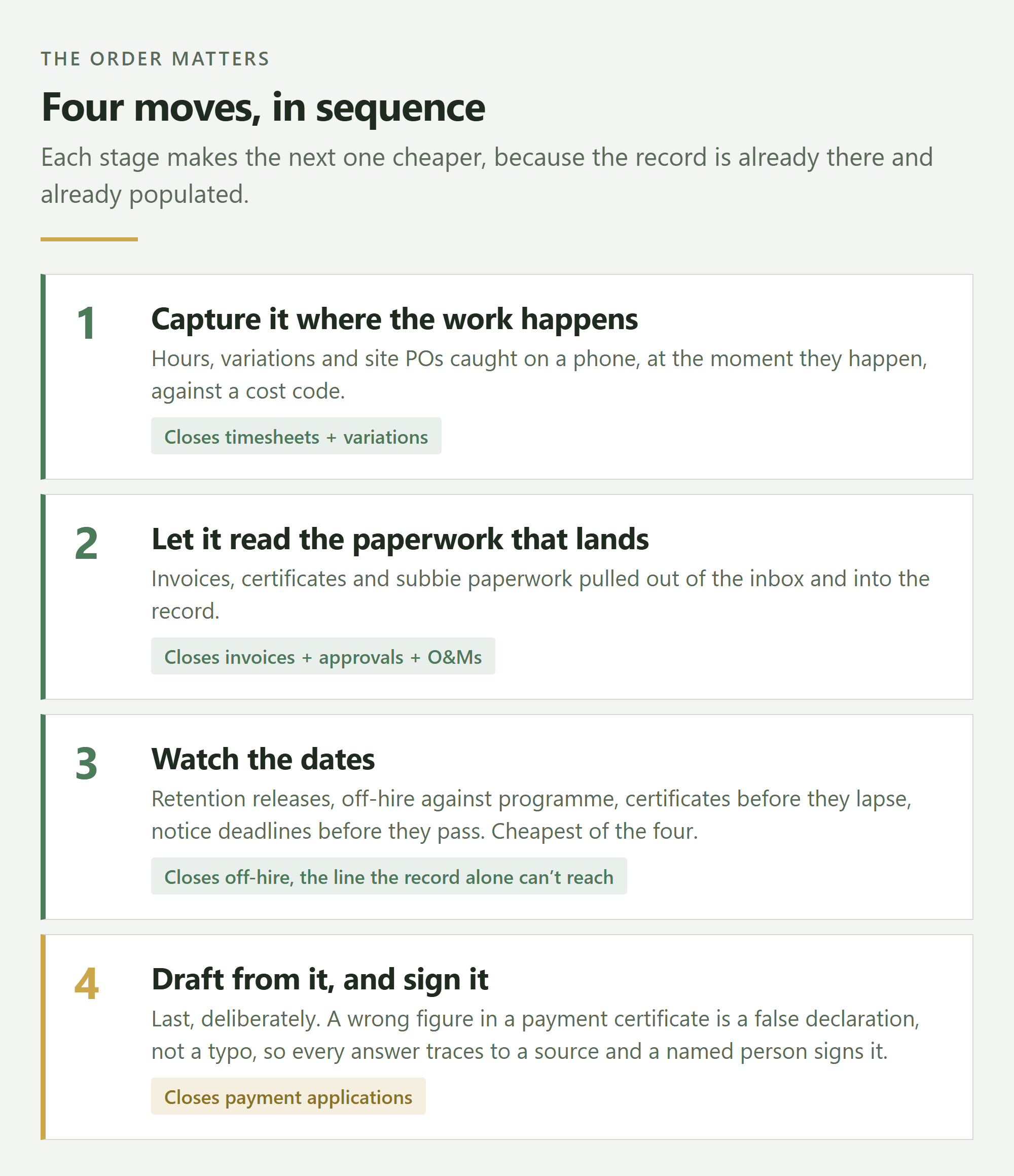
The record on its own saves nothing. Four moves built on top of it do, and the order matters.
- Capture it where the work happens. Hours, variations and site POs caught on a phone, at the moment they happen, against a cost code. Closes timesheets and variations, the biggest line in the ledger.
- Let it read the paperwork that lands. Invoices, certificates and subbie paperwork pulled out of the inbox and into the record. Closes invoices, approvals and most of the O&Ms.
- Watch the dates. Retention releases, off-hire against programme, certificates before they lapse, notice deadlines before they pass. Cheapest of the four, and it closes the one line the record alone can't reach.
- Draft from it, and sign it. Last, deliberately. A wrong figure in a payment certificate is a false declaration, not a typo, so every answer traces back to a source and a named person signs it.
On move three, start with retention. Multiply your turnover by your retention percentage and set it against your net profit. For most contractors the retention is the bigger number, and it gets released against dates nobody in the business is holding.
And settle one thing before any of it, because it's the sentence that stops most of these projects: where the data sits, whether anything you send is kept or used to train a model, and who can get at it. Privacy was the only adoption barrier that rose materially in RICS's 2026 survey of 3,148 property and construction professionals, 22% to 30% in a year, while worry about cost fell. It's a procurement question, not a technical one.
What you end up with
The first build carries the cost. By the fourth, closing another line is a small piece of work rather than a project.
That's the real return, and it isn't a headcount saving. A back office that was full running three sites runs four on the same people. The 1,032 hours don't come back as idle time. They come back as the capacity to take the next job without hiring for it first.
None of the arithmetic above is a benchmark. Size each workflow in hours, set an honest reclaim rate against each one, apply your own rates, keep hours separate from cash leaked and revenue unclaimed, then compare the total to net profit rather than turnover.
Most firms find the total surprising. Not because any single number is large, but because nobody had added them up.
Run your own seven lines
List the workflows that eat hours. Size each one. Set an honest reclaim rate against it. Keep hours, cash leaked and revenue unclaimed apart, because conflating them is how these numbers get dismissed. Then put the total against net profit, not turnover.
If you'd rather not do the arithmetic on your own, I'll do it with you. Thirty minutes, your workflows, your rates, and you keep the ledger whether or not we ever work together.
And if you run a contractor and think I've got a number wrong, I'd genuinely rather hear it. The variations line is the softest figure on the page. I'd like to replace my assumption with somebody's actual data.